

Guide to Low GWP Refrigerant Changes
There is an increasing concern about the effect refrigerants are having on our planet in terms of their potential to trap heat in our atmosphere, a process commonly known as the Greenhouse Effect. To address these concerns, governments around the world are implementing refrigerant regulations to phase out refrigerants they believe pose too much risk to global warming. To do this they use a rating system which assigns a Global Warming Potential (GWP) number to refrigerants.
What is GWP?
Global warming potential measures how much infrared thermal radiation a material has contributed to the atmosphere. The GWP is base lined on the effect of natural Carbon Dioxide (CO2) to trap heat in the atmosphere. CO2 has a GWP of 1. Two of the more common refrigerants used in air conditioning and process chillers today are R-134a with a GWP of 1,430 and R-410A with a GWP of 2,088. What that means is R-410A has 2,088 more Greenhouse Effect than CO2.
Why is GWP important for refrigerants?
Many new refrigerant regulations and laws coming into effect have mandated a GWP of 750 or less. This has driven a major investment in research and development of new refrigerant and refrigerant components as well as changes to the manufacturing, installation, and maintenance of refrigeration systems and low-GWP chillers.

Rules and Enforcement Dates on High GWP Refrigerants
In 2016, the Environmental Protection Agency (EPA) passed a ruling known as the Significant New Alternative Policy (SNAP) 21, which prohibited the use of high GWP refrigerants in new centrifugal and positive displacement chillers nationwide, effective as of January 1, 2024. However, this ruling was vacated by the court system a few years later. The California Air Resources Board (CARB) responded by enacting their own version of SNAP 21 on a state level, keeping in line with the original enforcement date. Additionally, 11 other states passed similar state-wide legislations restricting and banning high GWP refrigerants as of January 1, 2024.
In 2021, the EPA began working on the Technology Transition Rule. Similar to SNAP 21, it regulates through sector-based high-gwp refrigerant restrictions. However, this time it is based on the legal foundation set forth in the American Innovation and Manufacturing (AIM) Act which was passed into law the previous year. The Technology Transition Rule is still pending approval, but it would require new chillers to use refrigerants below 700 GWP starting on January 1, 2026.
Global Warming Potential Regulations Timeline
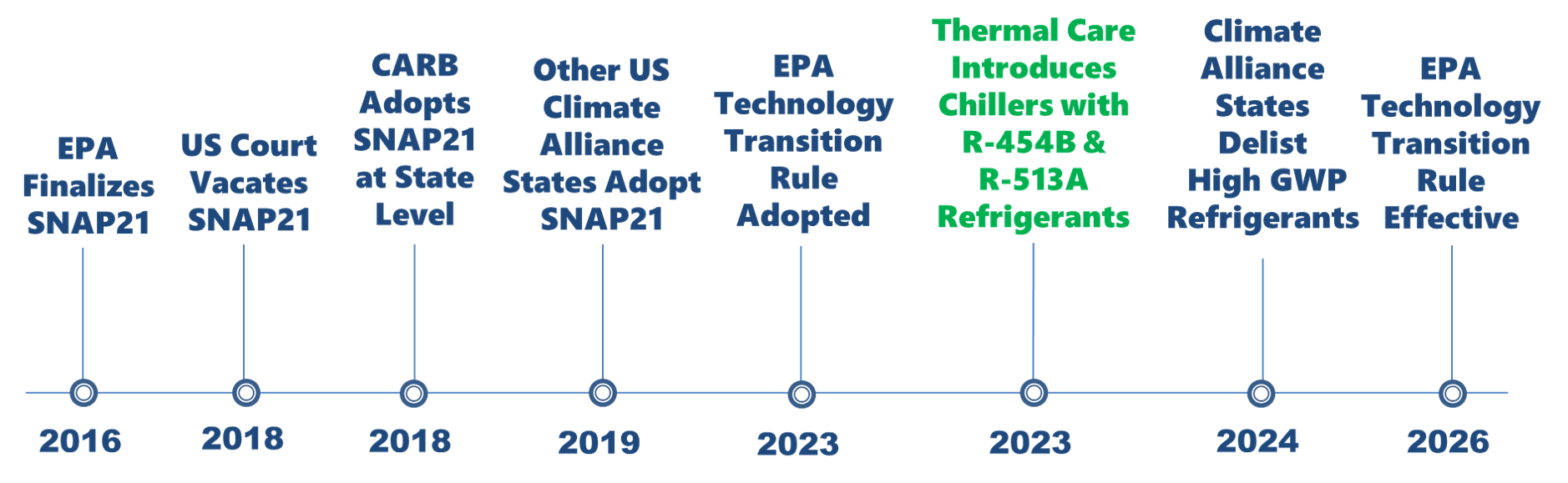
The multitude of rulings and enforcement dates, along with the tight deadlines of the state regulations have left manufacturers conflicted and confused. Combined with the fact that low GWP refrigerants have different thermodynamic properties than high GWP refrigerants, so major component changes are required, many companies may find themselves unprepared or unable to produce equipment with the new components needed.
Thermal Care Offers Low GWP Refrigerants & Products
Thermal Care began researching and preparing for these changes several years ago, and had implemented changes prior to any regulation deadlines. Thermal Care was able to provide the appropriate low GWP chiller and refrigerant solutions to meet customer needs long before the January 1, 2026 national deadline. While other manufacturers may still be struggling to find the right components, we began implementing multi-refrigerant compressors in early 2023. This allowed us to offer low GWP compliant chiller products, well ahead of the required deadlines, and to maintain the same cooling capacities and physical dimensions as our previous products. We selected R-454B as our alternative to R-410A and R-513A as our alternative to R-134a. R-134a, R-410A, and R-513A are all classified as A1 refrigerants by ASHRAE, meaning they are non-toxic and non-flammable. R-454B is classified as an A2L refrigerant, indicating it has a low level of flammability. While this classification means it is slightly flammable, R-454B is much closer in behavior to nonflammable A1 refrigerants than to highly flammable A3 types like propane. For safety and compliance, end-users should ensure that appropriate protective equipment is installed according to local and federal codes and regulations. It is important for the installing contractor or owner to verify that the refrigerant’s Global Warming Potential (GWP) values meet all applicable state and local requirements.
The transition to low GWP chillers was a necessary effort to reduce greenhouse gas emissions and protect the environment. Thermal Care stands out as a forward-thinking manufacturer, having proactively anticipated industry transitions and regulatory requirements. By offering low GWP compliant chillers and products well in advance of mandated deadlines, Thermal Care demonstrated both deep expertise and a commitment to sustainability—empowering customers to address climate change with confidence and compliance from day one.
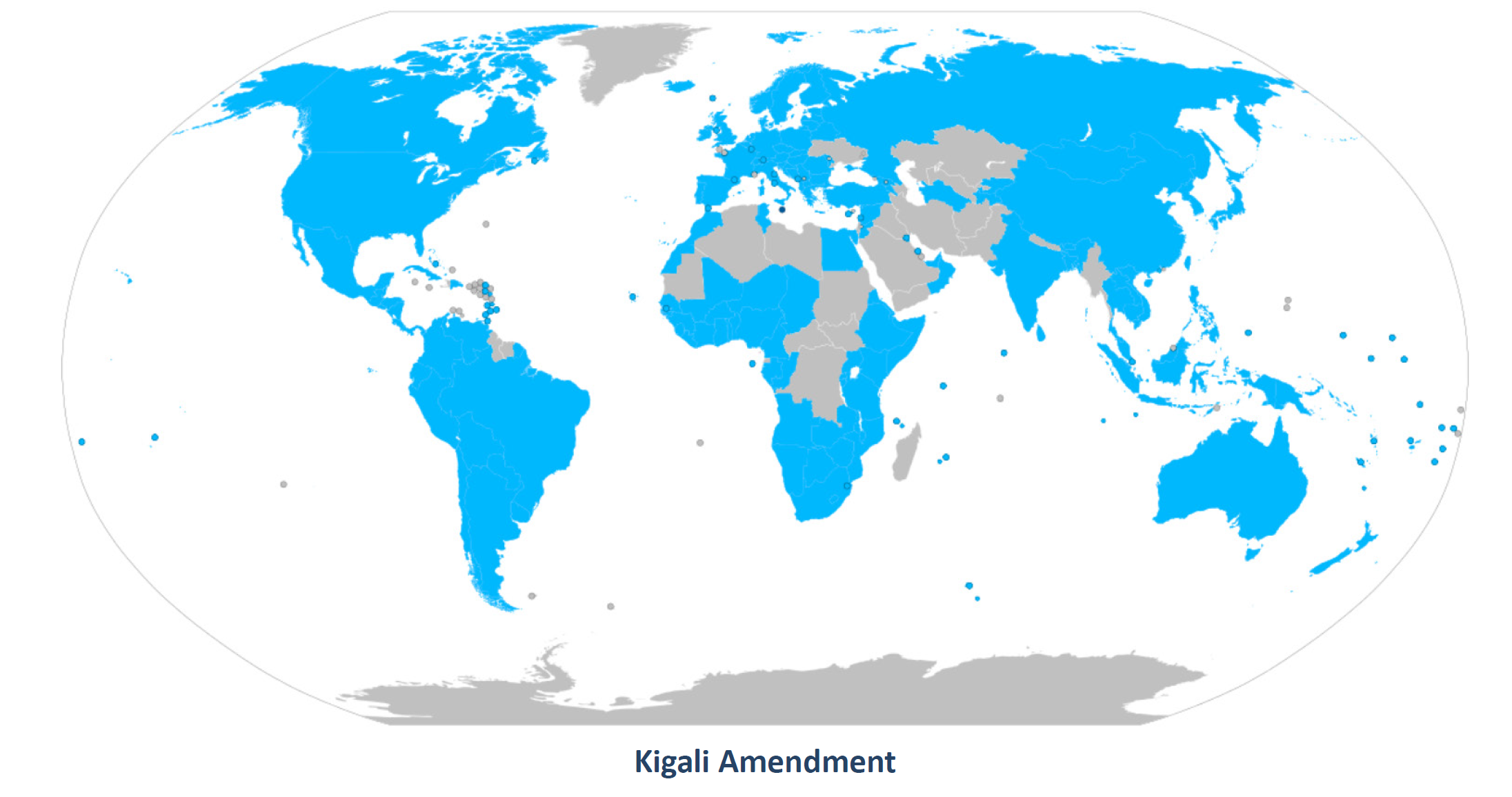
States with Upcoming Low GWP Installation Guidelines
The transition to low GWP chillers was necessary to reduce greenhouse gas emissions and protect the environment, but it did have substantial effects on chiller manufacturers. Those that could successfully shift to low GWP chillers were well-positioned to succeed.
Thermal Care is one example of a manufacturer that was prepared for this transition and offers low GWP compliant chillers and products. The transition to low GWP chillers at Thermal Care was well ahead of the required deadlines and helped to make a difference in the fight against climate change.
