

How does a chiller work?
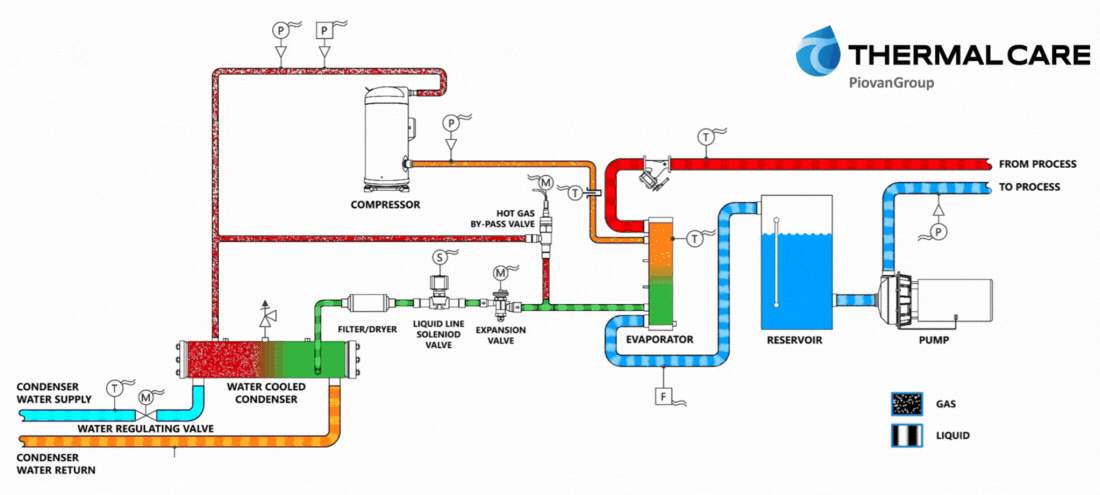
A chiller works by using a refrigeration cycle to absorb heat from a cool water or a water/glycol solution, and releasing it into the surrounding environment. Process chillers utilize a pumping system that circulates the cool water or water/glycol solution from the chiller to the process. A chemical compound, called a refrigerant, cools fluids through a cycle of compression and phase change. Which is the changing of a refrigerant from a liquid to a gas and back to a liquid. This process of heating and cooling a refrigerant and changing it from a gas to a liquid and back again is referred to as the refrigeration cycle.
What is a Chiller?
An industrial water chiller is a machine designed to provide consistent temperature and pressure in industrial processes by removing heat from liquid or space and transferring it to a cooling medium. Industrial chillers are used in a variety of applications where chilled water or liquid are circulated through the process equipment. Commonly used to cool products and machinery, water chillers are used in a multitude of different applications including injection molding, tool and die cutting, food and beverage, chemicals, lasers, machine tool, semi-conductors, HVAC systems and more.
The function of an industrial chiller is to move heat from one location (usually the process equipment or product) to another place (usually the air outside the manufacturing facility). It is very common to use water or a water/glycol solution to transfer the heat to and from the chiller, which may require the process chiller to have a reservoir and pumping system. Regardless of your industry and process, making sure that you have sufficient cooling is critical to productivity and cost savings.
What are the Key Components of a Chiller?
- Evaporator: Evaporators are heat exchangers that transfer heat from the process fluid into the refrigerant causing a phase change, evaporation. Refrigerant enters the evaporator as a low-pressure liquid/vapor mixture and exits as a low-pressure gas. The change of state from liquid to gas occurs at a constant temperature and absorbs energy. A chiller’s evaporator achieves superheated refrigerant vapor. Superheat is when all the liquid refrigerant has evaporated, and the gas temperature increases above its saturation temperature. The process fluid enters as a hot liquid and exits at a lower temperature after transferring energy to the refrigerant.
- Compressor: A compressor takes low pressure refrigerant vapor from the chiller’s evaporator and compresses it, causing an increase in pressure and temperature in the refrigerant. The result is a hot, high pressure gas that is then discharged to the condenser. Without a compressor the chiller system would be unable to cycle refrigerant as it creates the necessary amount of pressure to circulate it throughout the entire chiller system, ultimately facilitating cooling.
- Condenser: The function of a condenser is to convert heat from a refrigerant vapor and condense it into a liquid. This process works by circulating water between a cooling tower and the condenser in water-cooled chillers or blowing cool air over the piping of a condenser in air-cooled chillers. As a result, the condenser allows a chiller to release heat through condensation as it cools refrigerant gas back into a liquid in the form of condensation.
- Expansion Valve: In a chiller system, the expansion valve controls the flow of refrigerant from the condenser to the evaporator. The expansion valve achieves this by lowering the pressure of the refrigerant liquid which causes a phase change from a liquid to a low pressure gas. Thus allowing the refrigerant to absorb heat and readily evaporate it once it enters the evaporator component.
What are the Steps of the Chiller Refrigeration Cycle?
The refrigeration cycle begins with a low-pressure liquid/vapor mixture entering the evaporator. In the evaporator, heat from the process water or water/glycol solution boils the refrigerant, which changes it from a low-pressure liquid to a low-pressure gas. This low-pressure gas then enters the compressor where it is compressed to high-pressure gas. The high-pressure vapor enters the condenser where ambient air or condenser water removes heat to cool it to a high-pressure liquid. The high-pressure liquid travels to the expansion valve, which controls how much liquid refrigerant enters the evaporator, thereby beginning the refrigeration cycle again.
What is the Difference Between Air-Cooled and Water-Cooled Chillers?
Chillers are differentiated by the type of condenser used in the chiller: Air-Cooled or Water-Cooled condenser. An air-cooled condenser uses ambient air to cool and condense the hot refrigerant gas back down to a liquid. It can be located inside the chiller or can be remotely located outside, but ultimately it rejects the heat from the chiller into the air. In a water-cooled condenser, water from a cooling tower cools and condenses the refrigerant.
What is the Importance of a Chiller?
No industrial process, machine, or motor is 100% efficient, with heat being the most common byproduct of those inefficiencies. Chillers are important to industrial processes and machines because if heat is not removed, it will accumulate over time causing reduced production times, equipment shutdowns, and even premature equipment failure. It is necessary to incorporate cooling into industrial process system design to avoid these issues.
Using a chiller to provide cooling has multiple benefits. A chiller provides consistent temperature and pressure to your industrial process. Eliminating temperature and pressure variables simplifies the process development and optimization, ensuring the highest quality product. Instead of a wasteful, single-pass-through system, a chiller recirculates the cooling water. The recirculation minimizes the cost of water consumption which can be expensive and environmentally unfriendly.
What Chiller Works Best for Your Process?
Chiller systems range vastly in size and design and are available as small, localized or portable chiller units for smaller applications or large central chillers designed to provide cooling for entire processes.
If you are interested in more details on the best cooling solution for your application please contact a Thermal Care specialist.
