

Data Center
Data Center computers generate a tremendous amount of heat and without proper heat removal the lifespan of the server will be significantly reduced. Maintaining a balanced room temperature is critical to the data cooling process and the need goes beyond comfort cooling. Computer Room Air Conditioning (CRAC) units and single or two-phase immersion cooling are reliable, efficient heat rejection options essential to a data center’s design.
A trusted name for over 50 years, Thermal Care is a leading manufacturer of industrial process heating and cooling equipment and systems in over 50 different industries. We are experts in heat rejection / heat transfer systems and can perfectly support mission critical data center cooling needs.


Heat Rejection Systems can match an increasing demand to ensure reliable operation and maintain the system’s overall PUE as low as possible.

User friendly PLC control system provides intuitive operation, advanced diagnostics, and precise temperature control to deliver stable supply water temperatures.

Direct drive scroll compressor ensures low maintenance and high efficiency to maintain safe operating temperatures for IT hardware.
Process Chillers and Cooling Equipment
As data centers evolve to include servers beyond the traditional CPUs, like GPU and TPU, the kW/rack cooling requirements increase. Thermal Care’s Industrial Heat Rejection Systems can match that ever increasing demand to ensure reliable operation and maintain the system’s overall PUE as low as possible.
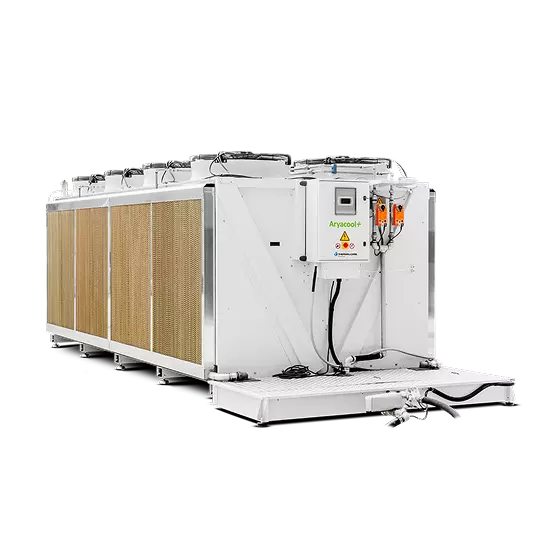
Count on Thermal Care application specialists to work with your engineers to help find the right heat rejection system for your specific need while minimizing your investment. Energy efficiency is achieved by utilizing a combination of advanced controls, adiabatic fluid coolers, and variable speed compressor technology to help minimize ongoing energy costs.
Whether using forced air cooling or immersion cooling, Thermal Care is the industry expert for your heat rejection needs. Thermal Care equipment and systems are proudly manufactured in the USA.
Products For Data Center
Frequently Asked Questions About Data Center Cooling Equipment
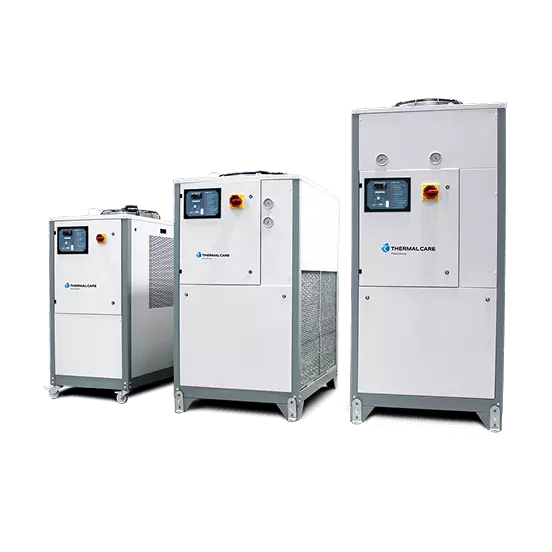
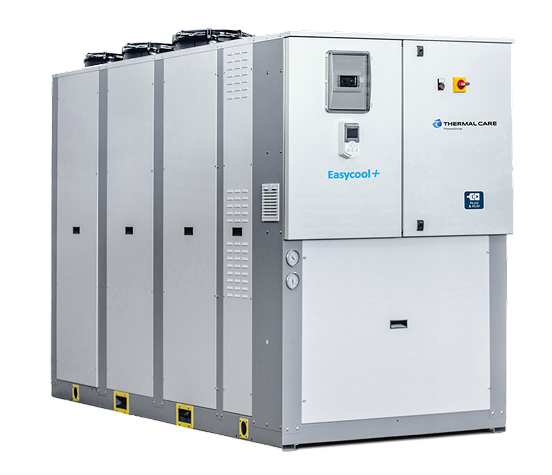
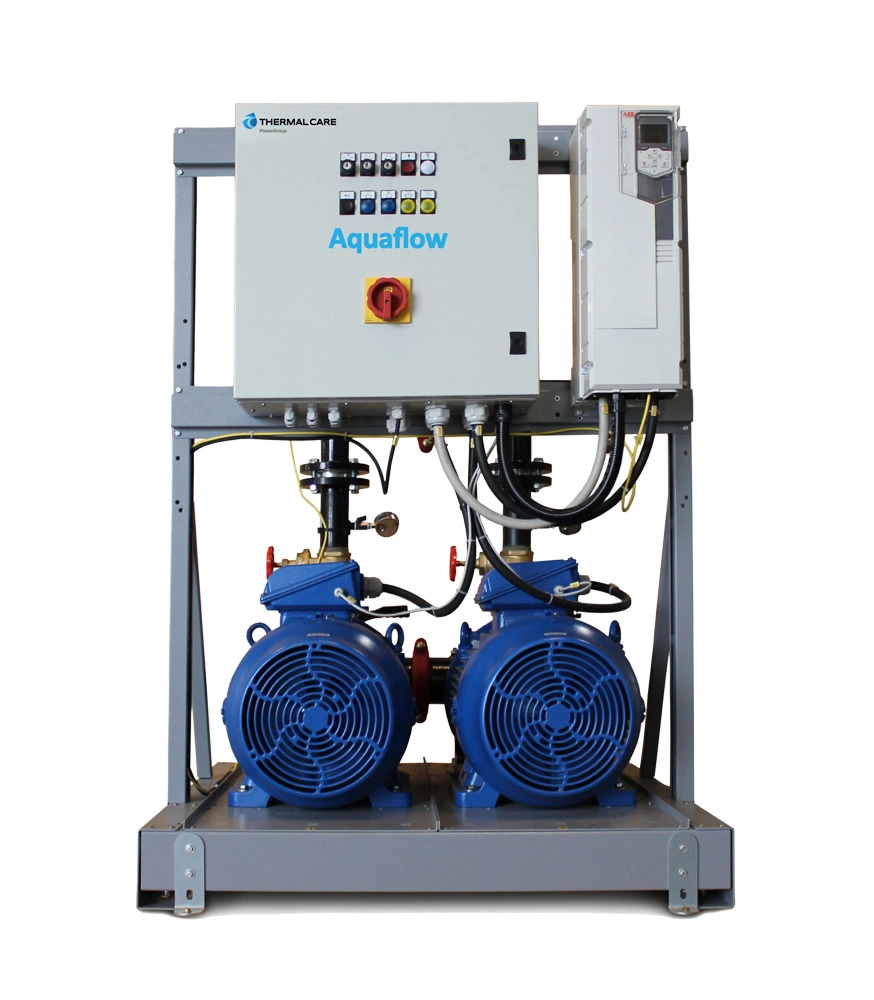
Our data center cooling equipment portfolio includes air- and water-cooled chillers ranging from 10 to over 700 tons per unit, paired with cooling towers, adiabatic fluid coolers, pump skids, and plant-wide controls. For smaller edge facilities and modular deployments, packaged outdoor chillers from the KSE Series provide a single-source solution, combining the refrigeration circuit, fans, controls, and electrical components in a single outdoor enclosure. Larger hyperscale and colocation builds typically combine multiple central chillers in a redundant N+1 or 2N arrangement, with either evaporative cooling towers or dry adiabatic coolers, depending on regional water availability and the operator's sustainability targets.
Modern AI training racks regularly exceed 50 to 100 kW per cabinet, well past what conventional air cooling alone can absorb. These loads are typically handled by rear-door heat exchangers, in-row cooling, or direct-to-chip liquid cooling loops that depend on a chilled water plant supplying technology cooling system water in the 75°F to 90°F range. Because the supply temperature is warmer than legacy 45°F chilled water, free-cooling hours expand significantly in most climates, and a properly specified central chiller plant with integrated cooling towers or adiabatic coolers can operate in economizer mode for much of the year, reducing compressor runtime.
Yes. Our chiller product lines have been updated with EPA-approved low global warming potential refrigerants, primarily R-454B and R-513A, well in advance of the AIM Act phase-down deadlines. This matters for data center operators because long-term lifecycle commitments and many sustainability reporting frameworks now require that newly installed cooling plants use refrigerants with lower GWP values. Specifying compliant equipment up front avoids the cost and disruption of mid-life refrigerant conversion projects later, and it protects the operator from regulatory changes that could otherwise force an unplanned plant retrofit during a high-occupancy production window.
Tier II facilities use redundant capacity components (N+1 chillers) but typically share a single distribution path. Tier III adds concurrent maintainability through multiple independent distribution paths for pumps, piping, and electrical service, allowing any single chiller, pump, or path to be taken offline for service without affecting IT operations. Tier IV designs use a fully fault-tolerant 2N arrangement with completely separate, isolated cooling systems.
Thermal Care supports installed equipment through factory-trained service technicians, a North American parts inventory, and remote diagnostic support that lets our engineers review controller logs with your on-site staff. For mission-critical data center applications, we recommend a documented preventive maintenance program covering refrigerant charge, condenser cleaning, water treatment, and controller firmware. Many operators schedule semi-annual inspections so any chiller can rotate through service during lower-load shoulder seasons without affecting capacity headroom. Standardizing this cadence across the plant also makes it easier to budget operational expenses year over year.
